The Carbon Calculus of Chiplets: When Modularity Meets Environmental Impact
As the semiconductor industry pushes the boundaries of performance and density, the pivot to chiplet-based, modular architectures has become the standard for high-performance SoCs. While the primary drivers of this transition are power scaling and yield optimization, a critical question for product teams is whether these architectural shifts are moving the needle on semiconductor sustainability.
It is common to assume that partitioning a design into smaller dies automatically lowers the environmental impact. However, carbon accounting in semiconductor manufacturing is nuanced. To provide the industry with a data-driven framework for making these decisions, we recently published a deep-dive analysis: When Do Chiplets Reduce Manufacturing Carbon? A Case Study of Apple M5 Pro.
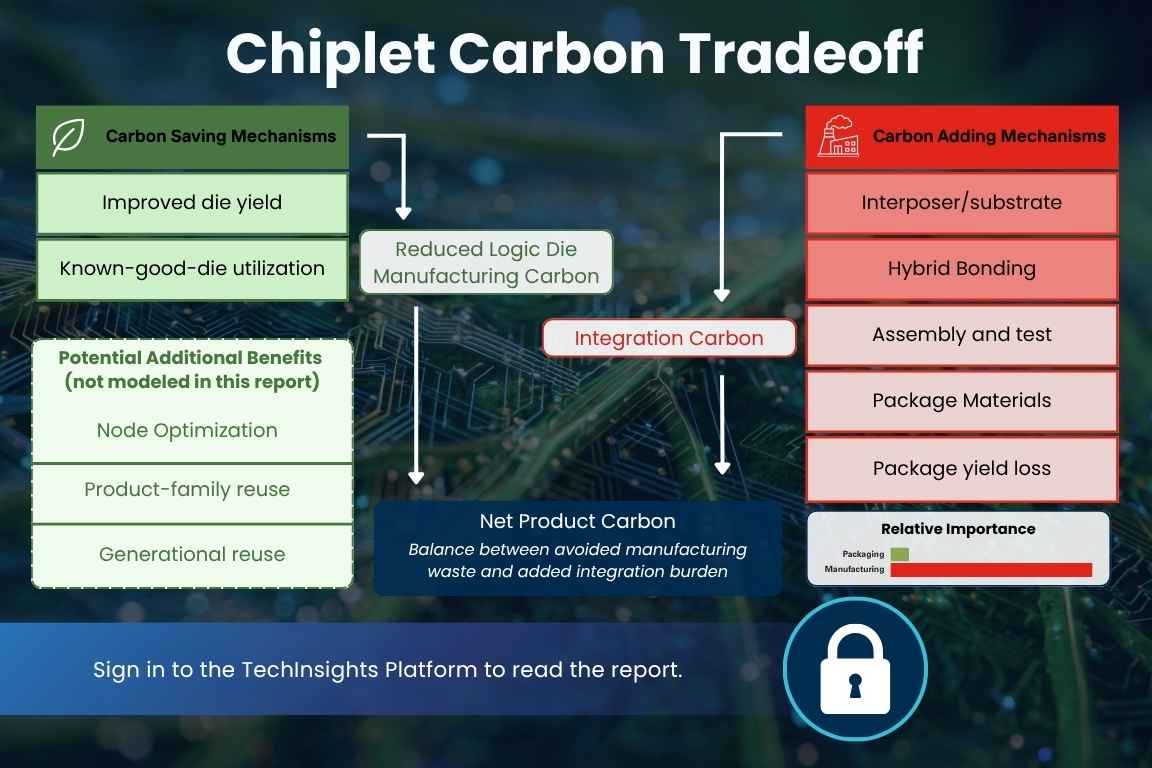
Figure 1 – Chiplet carbon tradeoff stack (Source: TechInsights)
The Yield-Complexity Tradeoff
To test the impact of this trade-off, our study modeled the Apple M5 Pro architecture against a functionally equivalent monolithic baseline. Our findings revealed that the modular architecture reduces total manufacturing carbon by approximately 6%.
This reduction is significant, driven primarily by a 30% improvement in logic-die manufacturing emissions. Yet, the impact is modest compared to the hype because the carbon burden of memory, assembly, and transport—which remain largely unchanged—dilutes the total product-level reduction.
Perhaps the most valuable takeaway from the report is the identification of the "break-even" point. Through a sensitivity analysis, we determined that the carbon advantage of chiplets is highly conditional:
- Yield Sensitivity: The carbon advantage of the modular architecture largely disappears once the equivalent monolithic yield reaches approximately 69%.
- Area Efficiency: The benefit evaporates if a monolithic design can be implemented using approximately 85% of the silicon area required by the modular design.
A Data-Driven Approach to Design
These findings demonstrate that for architects and supply chain managers, sustainability is an engineering decision rather than a default outcome. The move toward modularity provides a clear pathway to sustainable technology, but it is not a universal solution.
The industry’s path toward lower carbon is increasingly tied to understanding these thresholds before the first wafer hits the fab. When does modularity truly pay off for the planet? When the reduction in wafer-manufacturing waste demonstrably exceeds the added burden of integration and packaging.
For those involved in roadmap planning or product design, the goal is to treat carbon as a design constraint, using these data-driven thresholds to make informed, defensible decisions rather than relying on architectural assumptions.