Behind the Headlines
Every semiconductor announcement has two stories — the one on the surface, and the real story grounded in physical evidence, market data, and 35 years of reverse engineering. This is where you find the second one.

Memory, automotive, AI compute
Three stories about competitive advantages that look technical on the surface but are actually structural underneath. Samsung and SK hynix's memory race is really about architecture, not capacity; BYD's dominance in China was built by policy as much as by product; and NVIDIA's AI chip lead looks different once you separate who wins on revenue from who's actually winning on volume.
Samsung and SK Hynix Are Racing to Build Memory You Can Share, Not Just Store.
At OCP 2026, Samsung and SK hynix both detailed strategies for addressing the memory demands of agentic AI's key-value cache workloads, with coverage framing the announcements as further evidence that memory suppliers are racing to keep pace with AI's ever-expanding appetite for capacity.
The more interesting shift isn't how much memory agentic AI needs — it's that the industry just crossed a genuine architectural inflection point in how that memory gets shared. CXL memory pooling, which lets GPU clusters dynamically borrow DRAM from a shared pool rather than each accelerator hoarding its own dedicated capacity, has moved from forecast to production in 2026, running on next-generation Intel and AMD server platforms. That's not a minor technical footnote: pooling revenue is on pace to overtake traditional memory expansion by 2027 to 2028, arriving earlier than prior forecasts anticipated, and by 2031 pooling is expected to represent roughly half of all CXL-equipped servers. The reason this matters more than a simple capacity story is what it solves: the “stranded memory” problem that has plagued multi-tenant cloud architectures for years, where one server sits on idle DRAM capacity while a neighboring server runs out, with no way to share the difference. Agentic AI's KV cache workloads are an ideal forcing function for this shift, since they require large, bursty, and unpredictable memory footprints that are poorly served by fixed, siloed allocation. For Samsung and SK hynix, competitive positioning in this new mode isn't just about who ships the most DRAM bits — it's increasingly tied to process node leadership and advanced packaging capability, since CXL pooling modules demand the same kind of base-die co-design expertise already reshaping HBM competition. For executives planning datacenter infrastructure or memory sourcing strategy, the practical takeaway is that “memory capacity” is becoming a less useful unit of analysis than “memory architecture”: a server fleet that can pool memory across a fabric effectively has more usable capacity than its raw DIMM count suggests, and sourcing decisions that don't account for CXL readiness risk overbuying dedicated capacity to solve a problem that pooling could address more efficiently.
Market Data: DRAM and The McClean Report April 2026: Memory (DRAM, NAND, NOR) Market Update provide the full CXL demand and pooling forecast detail. These reports may require a paid TechInsights Platform subscription.
BYD's Real Advantage Over Foreign Automakers in China Isn't Engineering. It's Policy.
BYD closed out 2025 as the clear majority producer of China's passenger EVs, with coverage largely crediting the company's manufacturing scale, battery vertical integration, and aggressive pricing for its dominance over the foreign joint ventures that once controlled the Chinese auto market.
Scale and vertical integration are real advantages, but they're downstream of something more structural: China's NEV dual credit system, which has spent a decade quietly redirecting capital from foreign joint ventures toward domestic NEV champions like BYD. The mechanism is straightforward but consequential — automakers that fall short of NEV production credits must buy surplus credits from companies that exceed them, and because BYD's entire manufacturing base runs on electrified powertrains with in-house battery cells and power semiconductors, it accumulates credit surplus at a scale most foreign JVs, built around legacy ICE portfolios, have never been able to match. That dynamic shows up directly in the semiconductor demand data: BYD has led global HEV/EV semiconductor demand since 2024, now running meaningfully ahead of Tesla, while GM and Honda's JV-dependent China operations sit at a fraction of BYD's footprint. PHEVs are the sharpest edge of this advantage, since the credit framework awards full NEV credit value to plug-in hybrids, and BYD's DM-series architecture — offering over 1,000 km of combined range — has no real foreign JV equivalent built for Chinese consumer preferences and credit optimization at the same time. The joint-venture model carries a second, slower-acting cost that compounds the credit disadvantage: the IP and engineering knowledge foreign automakers shared with Chinese JV partners over decades has become training material for those same partners' independent EV platforms, some of which now compete directly against the foreign brands that helped build them. None of this means BYD's position is unassailable going forward — rising EU, US, and Canadian tariffs on Chinese EVs create a real ceiling on how much of this domestic advantage BYD can convert into global share, a constraint playing out visibly at events like the Paris Motor Show, where European OEMs are explicitly trying to reclaim ground on their own home turf. For executives assessing competitive risk from Chinese automakers, the practical lesson is to look past the product spec sheet: BYD's advantage was manufactured by policy architecture as much as by engineering.
Market Data: Automotive Semiconductor TAM by OEM Group and Analysis: Paris Motor Show 2026 – European OEMs Seek to Reclaim Their Home Market provide deeper competitive detail. These reports may require a paid TechInsights Platform subscription.
NVIDIA Still Wins AI Chips on Revenue. It's Already Losing on Volume.
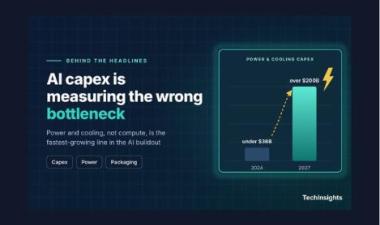
Industry forecasts project AI rack capital expenditure more than quadrupling by 2027, with coverage treating the figure mainly as confirmation that NVIDIA's dominance of the AI accelerator market will keep deepening alongside the broader hyperscaler spending boom.
The capex figure is real, but it obscures a shift already well underway beneath NVIDIA's continued revenue leadership: custom silicon built in-house by hyperscalers — Google's TPUs, Amazon's Trainium and Inferentia, Meta's MTIA, Microsoft's MAIA — has already overtaken merchant GPUs in unit shipments, and the gap is set to widen. Custom silicon is forecast to represent roughly 70% of AI accelerator shipments by 2027, compounding at nearly double the growth rate of merchant GPU silicon, driven by cost optimization, supply chain independence, export-control risk mitigation, and a straightforward technical fit: inference workloads, which now dominate AI compute demand, are far more amenable to fixed-function custom architectures than the general-purpose flexibility NVIDIA's GPUs are built to provide. That doesn't mean NVIDIA's position is actually weakening in the way “losing on volume” might suggest at first read — NVIDIA's Blackwell and upcoming Rubin architectures, backed by the CUDA software ecosystem, continue to command premium revenue share in training-heavy deployments, where raw volume matters less than per-unit value and software lock-in. The more useful way to read this split is that the AI accelerator market has quietly bifurcated into two separate competitive games: a training-focused, revenue-dense market where NVIDIA's software moat still dominates, and an inference-focused, volume-dense market where hyperscalers increasingly prefer building their own silicon over paying NVIDIA's margins. For any executive whose strategy still treats “the AI chip market” as a single competitive arena with NVIDIA simply winning it, that framing is already behind the data. The more consequential planning question is which of the two markets your business actually depends on, because conflating the two risks missing where the real volume, and the real structural change, is actually happening. Export controls add a further wrinkle worth tracking: restrictions on high-end GPU exports to China are accelerating domestic alternatives like Huawei's Ascend family, meaning the bifurcation is geographic as well as architectural.
The McClean Report: AI Accelerator Review and Update (September 2026) and Market Data: Datacenter CAPEX and Servers provide the full shipment and capex model. These reports may require a paid TechInsights Platform subscription.
Packaging, image sensors
Two engineering stories, two reminders that being the better technology isn't the same as the best practical choice. Glass substrates beat organic ones on nearly every spec except cost and manufacturing readiness, while OmniVision's industrial push is really evidence of a company that already stopped being defined by its original market.
Glass Substrates Are Better Than Organic Ones at Almost Everything Except Being Affordable.
Glass core substrates are increasingly discussed as the eventual successor to the organic substrates used in advanced chip packaging, with coverage highlighting their superior flatness, thermal stability, and routing density for large AI accelerator packages.
The engineering case for glass is genuinely strong and well-documented — better dimensional stability, finer routing, lower dielectric loss, and the ability to support larger, more complex chiplet packages than organic substrates can reliably handle at scale. What that framing undersells is that glass's advantages come bundled with a structural cost and manufacturing problem that no amount of material superiority solves on its own. Glass core processing requires an almost complete retooling of the substrate supply chain: laser-based via formation instead of mechanical drilling, new handling protocols for a brittle, ceramic-like material prone to fracture during dicing, and entirely new equipment investments that suppliers must commit to before industry standards for panel size or via geometry are even settled. That's why glass core remains, as of 2026, confined to pilot lines and early qualification programs for the highest-end AI accelerator packages, rather than a broad substrate replacement. Intel and TSMC are both pursuing distinct panel formats, with TSMC's glass-based CoPoS platform not expected to reach volume until around 2028. For executives in the packaging and substrate supply chain, the practical read is that glass core is a real, arriving technology, not a replacement to plan a broad product roadmap around…yet. It will matter enormously for the specific slice of the market building the largest AI accelerators, and remain economically irrelevant for nearly everything else for several more years.
Advanced Packaging for 2.5D and 3D Integration — Technology Survey goes deeper on the technical and competitive landscape. This report may require a paid TechInsights Platform subscription.
OmniVision Quietly Stopped Being a Smartphone Camera Company.
OMNIVISION announced new image sensor products aimed at industrial vision, robotics, and factory automation at AutoSens Europe, with coverage framing the launch as a straightforward product-line expansion into adjacent growth markets for an established mobile camera sensor supplier.
The more consequential fact sits in OmniVision's own financials rather than in this specific product announcement: 2025 was the first year non-mobile revenue exceeded mobile revenue, a genuine structural inflection for a company whose identity has been built around smartphone cameras for two decades. Automotive, not industrial, has actually been the primary engine behind that shift, nearly tripling in four years as OmniVision pushed into driver-monitoring systems with a dedicated automotive ASIC that bundles image signal processing, a programmable deep-learning accelerator, and compute directly alongside the sensor — a system-level “companion processor” strategy that pure sensor suppliers competing on component specs alone can't easily match. The new industrial and robotics push announced at AutoSens fits the same playbook: emerging applications, including robotics perception and AI endpoint vision, are OmniVision's fastest-growing category by percentage, even if still smaller in absolute dollars than automotive. For competitors and customers, the useful signal isn't the specific sensors announced at the show. It's that OmniVision has methodically repositioned itself from a single-market commodity supplier into a multi-vertical, system-level player, and its Chinese ownership, paired with Silicon Valley engineering and TSMC manufacturing, gives it geographic flexibility that single-region competitors may struggle to replicate as this diversification continues.
Special Report: Design Win Tracking - Image Sensor and Technical Report: STMicroelectronics VL53L9CX 3D LiDAR d-ToF Device Essentials Plus provide deeper and comparative context on the industrial/robotics sensor space. These reports may require a paid TechInsights Platform subscription.
Battery supply, regulatory compliance
Two procurement stories, two cases where the obvious read is the less useful one. LGES's flexibility, not CATL's raw scale, may be the more valuable hedge for customers worried about demand shifts, and the EU's looming battery passport deadline is less a compliance burden to survive than a demand tailwind for the European chipmakers positioned to help you meet it.
LGES Turned GM's Castoff Plants Into Its Biggest Competitive Advantage.
At Battery Show 2026, coverage focused on LG Energy Solution's ability to repurpose battery plants originally built for General Motors into flexible, multi-customer facilities, framing CATL as the battery industry's clear scale leader and LGES as a smaller rival finding creative ways to stay relevant.
The “smaller rival” framing undersells what LGES has actually built. CATL's dominant capacity position is real; its China-concentrated footprint alone exceeds 600 gigawatt-hours annually. But that scale comes with a geographic concentration that LGES's joint-venture strategy deliberately avoids. LGES now operates battery capacity through partnerships spanning GM, Honda, Hyundai, Stellantis, Ford, and a Renault/CATL joint venture across the US, Europe, and Asia, giving it diversification that CATL's largely China-anchored footprint doesn't match, regardless of total gigawatt-hours. That diversification is precisely what makes a plant like the former GM-dedicated Ultium facility valuable even after GM's own allocation needs shift: LGES can redirect output toward whichever partner currently needs it most, rather than sitting on stranded capacity built for a single customer's now-changed demand. This is a direct extension of a dynamic flagged in this newsletter previously, when GM's Lansing plant began supplying Toyota and grid-storage customers after GM gave up its allocation rights along with its equity stake — the same logic is now playing out across LGES's broader JV portfolio, not just one facility. For procurement and supply-chain executives negotiating battery capacity agreements, the lesson compounds: CATL's scale is the safer bet if your priority is raw volume and price, but LGES's multi-customer flexibility is the better hedge if your priority is capacity resilience against any single customer's demand changes — and cell supply is already emerging as the binding constraint on Europe's 800V vehicle rollout, meaning the flexibility question is about to matter more, not less, over the next several years.
Battery Technology Manufacturing Capacity Forecast provides the full capacity and constraint detail. This report may require a paid TechInsights Platform subscription.
The EU's Battery Passport Deadline Is Actually Good News for Europe's Chipmakers.
TechInsights' review of 28 automakers and Tier 1 suppliers finds readiness gaps ahead of the EU's battery passport deadline, with coverage framing the looming compliance requirement primarily as a regulatory burden and operational risk for automotive supply chains racing to digitize battery data before the deadline hits.
The compliance-burden framing misses what this regulation actually does for Europe's semiconductor industry, arriving at a moment when that industry badly needs a tailwind. The battery passport requires granular, continuous tracking of cell-level battery health and raw material origin, which translates directly into higher-value semiconductor content: more capable battery management chips, secure elements for tamper-resistant digital identity, connectivity ICs for data access, and continued displacement of silicon IGBTs by silicon carbide power devices, since the regulation's carbon-footprint disclosure requirement rewards more efficient power conversion. That demand lands squarely on Europe's three largest chipmakers — Infineon, STMicroelectronics, and NXP — each of which has spent the past two years navigating a genuine downturn in automotive and industrial demand. Infineon cut its revenue guidance citing weak automotive demand, and ST's analog sales softened after a strong prior year. A structural, multi-year compliance-driven demand catalyst arriving now is ideally timed for companies that have been waiting for a recovery inflection point. There's a competitive dimension too: the carbon-footprint declaration requirement may serve as a practical barrier to Chinese SiC suppliers that have aggressively expanded capacity in recent years, if their manufacturing carbon intensity is higher than that of European alternatives — turning an environmental compliance rule into something closer to a regional trade advantage for incumbent suppliers. For procurement and supply-chain executives, the real takeaway isn't just to assess your readiness gap before the deadline. It's that the suppliers best positioned to help you close that gap are the same European chipmakers this regulation is quietly subsidizing with new demand, which should factor into how you prioritize supplier relationships and capacity commitments heading into 2027.
Chip Observer: Outlook Report 2026 — 5 Top Expectations and The McClean Report: Regional Semiconductor Outlook (February 2026) provide deeper context on Europe's semiconductor competitive position. These reports may require a paid TechInsights Platform subscription.
Every semiconductor announcement has two stories.
Register with your corporate email address for full access to TechInsights research.
Register here