US Hyperscalers Now Drive 15 of the World’s Top 20 Datacenter Markets
- The US dominates hyperscale datacenter capacity: 15 of the world’s top 20 hyperscale datacenter markets were in the US, while the top 20 collectively accounted for 60% of global capacity.
- The geographic rankings are shifting: Texas hyperscale capacity grew 71% over the past year, compared with 36% worldwide, while markets including Indiana, Tennessee, Guangdong, Johor, and Jakarta are gaining ground.
- Leading cloud providers have the broadest global datacenter footprints: Amazon, Microsoft, and Google collectively account for 57% of all hyperscale datacenter capacity.
Synergy Research Group, now part of TechInsights, has updated its analysis of the world’s leading locations for hyperscale data center infrastructure. Just 20 state or metro markets accounted for 60% of global hyperscale datacenter capacity, with 15 of the top 20 located in the US.
Northern Virginia in the US and the Greater Beijing Area in China alone account for 17% of the worldwide capacity. They are followed by the US states of Oregon, Iowa, and Ohio, as well as the Dallas-Fort Worth area of Texas. Of the top 20 markets, 15 are in the US, four are in the Asia-Pacific (APAC) region, and just one is in Europe. The next 20 largest state or metro markets account for another 19% of global capacity, with locations outside of the US featuring more prominently in that group.
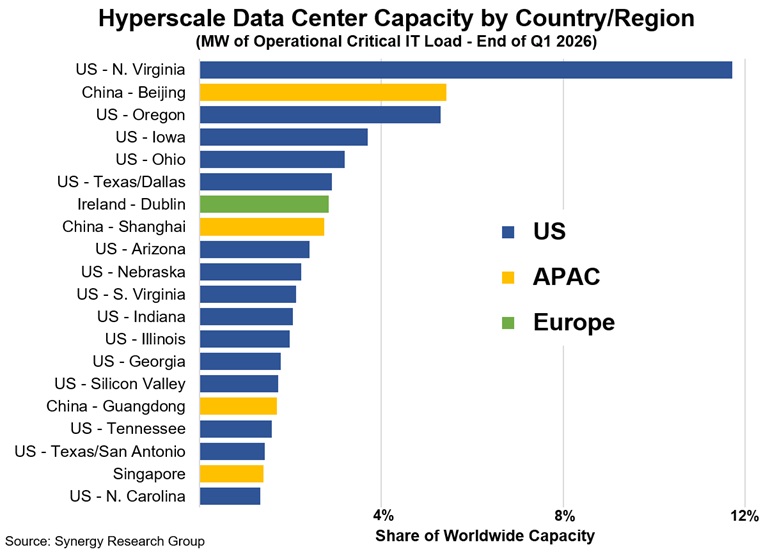
New data from Synergy Research Group shows that 15 of the top 20 data center metro markets are in the US as of Q1 2026. (Source: Synergy Research Group, now part of TechInsights)
Why Does the US Dominate Hyperscale Datacenter Capacity?
Notably, the US presence among the top 20 has also increased. There are now just five non-US locations in the top twenty, compared with six a year ago and seven two years ago. Since last year, Tokyo, Japan; Sydney, Australia; and South Carolina have dropped out of the top twenty, replaced by Indiana and Tennessee in the US, and Guangdong, China. Two factors help explain the concentration of hyperscale datacenter capacity in the US: 62% of the world’s hyperscale operators are headquartered in the US, including the four biggest, and the US accounts for almost half of the cloud market revenue across several key segments. Looking ahead, the US and China will continue to dominate the numbers, though several up-and-coming tier two markets will start to feature more prominently.
“Markets like Dublin, Amsterdam, and Singapore have dropped down the rankings over the last two years due to local constraints, and even Northern Virginia is not featuring as highly in new plans as it once did. Meanwhile, one of the biggest growth stories is Texas, whose operational hyperscale capacity has grown by 71% over the last year, compared with a worldwide average growth rate of 36%. Other high-growth markets include Indiana, Tennessee, and South Virginia in the US; Shanghai, China; Johor, Malaysia; and Jakarta, Indonesia. Our pipeline tracking of future hyperscale data centers shows that the ranking of locations will continue to shift over the coming years,” said John Dinsdale, Chief Analyst at Synergy Research Group
Which Companies Lead Global Hyperscale Datacenter Capacity?
The research analyzes the datacenter footprints of 21 of the world’s major cloud and internet service companies, including the largest operators in software as a service (SaaS), infrastructure as a service (IaaS), platform as a service (PaaS), search, social media, e-commerce, and gaming.
The companies with the broadest data center footprint are the leading cloud providers: Amazon, Microsoft, and Google. In addition to a huge data center footprint in their home US market, each also has multiple data centers in many other countries worldwide. In aggregate, the three now account for 57% of all hyperscale data center capacity. They are followed by Meta, Alibaba, Tencent, Oracle, Apple, ByteDance, CoreWeave, and then other relatively smaller hyperscale operators.
Synergy’s forecast growth numbers are largely based on its tracking of hyperscale operators’ pipelines of future data centers. Synergy’s known pipeline of future hyperscale data centers currently stands at 915 facilities at various stages of planning, development, or fit-out, providing a forward-looking view of how the geographic distribution of hyperscale infrastructure could continue to change.