Chip Observer: October 2026


Industry Observatory
Consumer Market Concerns 4
Artificial Intelligence Boom and Bust 5
Mergers, Acquisitions, and Funding Rounds 4
Lost and Foundry 6
Under the Microscope
Consumer Market Concerns
4 storiesA20 Pro brings TSMC N2 to the iPhone
Apple unveiled the iPhone 18 Pro, iPhone 18 Pro Max, and its first foldable, the iPhone Duo, on September 9, the first product launch under new CEO John Ternus. All three devices use the A20 Pro, Apple’s first 2nm processor and the first high-volume smartphone chip built on TSMC’s N2 process, which is also TSMC’s first gate-all-around (GAA) node. The phones went on sale on September 18.
TechInsights’ early analysis found that Apple kept a six-core CPU configuration but changed the core architecture, increased GPU and Neural Engine core counts, and made significant changes to the memory interface and physical packaging. Floorplan findings point to how strongly on-device AI is shaping Apple’s silicon design choices.
A premium-only fall lineup
Apple did not release a standard iPhone 18 this fall. The iPhone 18 Pro starts at $1,199, $100 more than its predecessor, the Pro Max starts at $1,299, and the iPhone Duo starts at $1,999. The standard iPhone 18, along with the iPhone Air 2 and iPhone 18e, is reportedly planned for spring 2027. Earlier reports linked Apple’s decision to prioritize premium launches in 2026 to the memory crunch, which hits lower-margin devices hardest.
TechInsights analysis
Report iPhone 18 Could Cost MoreMemory now dominates low-end device costs
Speaking at the AI Infrastructure Summit in Santa Clara on September 15, Intel CEO Lip-Bu Tan said memory chips now account for 70–80% of the cost of budget smartphones and laptops, and that memory prices have risen five- to sevenfold depending on the product category. TechInsights research shows the squeeze is already reshaping the device market: long-term contracts now largely decide which OEMs get memory supply, and Oppo has pulled OnePlus out of North America and Europe and Realme out of China, with the memory crisis a key factor.
TechInsights analysis
Insight Why Your Next PC Build May Cost More - The AI-Driven Memory Crunch Reshaping Consumer Tech Analysis Impact of Mobile Memory Supply Shortage Report OnePlus and Realme Exit - Casualties of the Memory Crisis Report Memory’s New Rules: Long-Term Contracts Now Decide Who Gets Supply Report Narrative: Global Smartphone Shipments Forecast by Vendor by Region, Sep. 2026Micron sees no relief before 2028
Alongside record fiscal Q4 results, Micron said memory supply will remain tight through 2028, with more than 75% of its 2027 output already committed under customer agreements. It also said 2027 HBM pricing will be significantly higher than 2026 levels. For consumer device makers, the message is that elevated DRAM and NAND costs are not a short-term spike, as wafer capacity continues to shift toward HBM and datacenter products.
TechInsights analysis
Report How AI Is Reshaping DRAM, NAND, Pricing, and the Global Memory MarketArtificial Intelligence Boom and Bust
5 storiesSlowdown call rattles chip stocks
Anthropic CEO Dario Amodei published an essay over the weekend of September 12–13 urging the industry to slow the pace of frontier AI capability gains, alongside a commitment to give independent evaluators expanded access to Anthropic’s models. OpenAI CEO Sam Altman and Elon Musk publicly backed the call. On September 14, the PHLX Semiconductor Index fell 5.9%, its worst session since July, and SoftBank dropped about 10.7%. Market watchers cited by Bloomberg expected limited long-term impact, because demand for chips, energy, and compute continues to outstrip supply.
Broadcom shares fell about 5% on September 14. The same day, CEO Hock Tan appeared on CNBC’s “Mad Money” to address the slowdown concerns and reaffirmed the company’s long-term AI revenue goals. Broadcom’s six major custom accelerator customers, which include Google, Anthropic, OpenAI, and Meta, are all ramping custom chip deployments over the next few years.
Memory makers post record numbers
Micron reported fiscal Q4 2026 revenue of $54.23 billion, up from $41.46 billion in the prior quarter and $11.32 billion a year earlier, with GAAP gross margin of 86.8%. Full-year fiscal 2026 revenue reached $133.19 billion, versus $37.38 billion in fiscal 2025. The company guided fiscal Q1 2027 revenue to $61.5 billion, plus or minus $1.5 billion, underlining how AI demand and memory pricing are reshaping the memory market’s economics.
The same forces are visible in trade data: South Korea’s semiconductor exports rose more than 262% year over year to a record $60 billion in September, according to the Ministry of Trade, Industry and Resources. The increase was driven by stronger memory demand, higher shipment volumes, and rising memory prices, and reflects the outsized share of AI memory supply held by SK hynix and Samsung.
Qualcomm lands Amazon as a datacenter customer
Qualcomm and Amazon signed a multi-generational agreement worth up to $60 billion to develop custom silicon for large-scale AI datacenters and AI inference, along with optical connectivity at up to 1.6T and future solutions. The deal is a major validation of Qualcomm’s datacenter push, which was strengthened by its acquisition of Alphawave Semi and its high-speed connectivity IP.
TechInsights analysis
Insight Qualcomm Accelerates AI Datacenter Strategy with Alphawave Semi AcquisitionHuawei leans on system-level scaling
Huawei unveiled an 11-chip AI portfolio spanning compute, interconnect, and storage. The company said its Ascend 960 processors will double the compute performance of the 950 series, with two variants arriving ahead of schedule in 2027. Huawei is relying on system-level scaling to offset limitations in individual chip performance, a strategy shaped by its restricted access to leading-edge process technology.
NVIDIA sees an opening in China
Chinese President Xi Jinping visited Washington on September 23–25, and NVIDIA CEO Jensen Huang was among the 134 guests at the White House state dinner. Following the summit, China’s Ministry of Industry and Information Technology reportedly asked ByteDance, Alibaba, and Tencent to disclose their plans to buy NVIDIA’s RTX PRO 5500, which launched on September 14. ByteDance alone is reportedly considering about 1 million units, and NVIDIA plans to begin shipping to China in late December at roughly 500,000 units per quarter. NVIDIA’s guidance had assumed no datacenter sales to China, and H200 shipments there were under 1% of datacenter revenue last quarter.
Mergers, Acquisitions, and Funding Rounds
4 storiesAnthropic’s prospectus puts Broadcom at the center of its buildout
Anthropic’s IPO prospectus, as reported by Reuters, shows that Broadcom has agreed to lend it up to $42 billion in convertible notes that could later convert into Anthropic shares. The financing could cover about a third of Anthropic’s $125.2 billion commitment for a five-year lease of tensor processing unit (TPU) computing capacity. Broadcom can designate a financing partner, and Anthropic does not expect any notes to be sold before its IPO. The filing flags potential conflicts of interest from Broadcom’s dual role as supplier and lender. Anthropic is set to become the largest customer of Broadcom’s chip design business next year, a prominent example of the reciprocal financing that has drawn scrutiny across the AI buildout.
The prospectus also shows revenue of nearly $4.6 billion in 2025, up from about $400 million in 2024, with computing and infrastructure costs of $7.33 billion and an operating loss of more than $8 billion. It also lists about $518 billion in planned cloud, compute, and infrastructure obligations, including roughly $161.2 billion to Broadcom, $111.1 billion to Google, $110 billion to Amazon, and $31.4 billion to Microsoft.
AMD buys into spatial intelligence
AMD agreed to acquire World Labs, the AI startup founded by Fei-Fei Li, for $8.2 billion in an all-stock transaction. World Labs develops spatial-intelligence AI models that simulate interactive 3D environments for robotics. The deal is expected to close by the end of 2026, subject to regulatory approvals.
Analog Devices targets physical AI
Analog Devices agreed to acquire Alif Semiconductor for $1.35 billion in cash, with an earn-out of up to $200 million, which could bring the total to $1.55 billion. Alif makes AI-native microcontrollers and fusion processors for real-time sensor fusion, low-latency inference, and on-device AI, and its silicon is already shipping, with consumer and industrial design wins. ADI says the deal advances its Physical Intelligence strategy. The acquisition requires US government clearance and is expected to close by the end of 2026.
Infineon sheds its NOR flash business
Infineon agreed to sell its NOR flash and F-RAM businesses to Winbond for $1.12 billion in cash, allowing it to concentrate resources on its core semiconductor businesses. The deal is expected to close in the second half of 2027.
Lost and Foundry
6 storiesTSMC looks to Texas
TSMC is reportedly evaluating a multibillion-dollar manufacturing campus in Texas for more AI chips, according to Bloomberg. The move would expand TSMC’s US footprint beyond Arizona, where its committed investment reached $265 billion after it pledged an additional $100 billion in July.
SK hynix and Intel discuss US memory production
Reuters reported on September 16 that SK hynix is in exploratory talks with Intel to manufacture memory chips in the US for the first time. One option would have SK hynix lease part of Intel’s Ohio fab; another would form a joint venture with Intel and major cloud providers. SK hynix said no plans or agreements have been finalized, and Intel called the report speculation. A deal would give Intel a marquee foundry tenant for its delayed Ohio campus, but could face technology-transfer review in South Korea.
Intel gains confidence on 14A
Speaking at a Deutsche Bank investor conference, Intel CFO Dave Zinsner said external 14A engagements have increased significantly and have moved from evaluating process data to discussing how much capacity customers can get. He said 14A’s defect rate is falling faster than targeted and that Intel has “conviction” it will land external customers. Intel raised about $23 billion in new capital this summer and plans 14A risk production in 2027, with high-volume manufacturing in 2028.
Samsung’s Taylor fab fills up
Samsung’s Taylor, Texas fab is reportedly fully booked for 2nm production before operations begin, with orders tied to Tesla’s AI5 and AI6 chips, Broadcom’s next-generation communications chips, and Arm. Trial operations were expected to start between late September and early October, with an initial capacity of about 50,000 wafers per month and volume production in 2027. Samsung Foundry has also gained pricing power, but is projected to hold only about 6% market share in semiconductor foundry in 2026, compared to roughly 73% for TSMC.
TechInsights analysis
Report Samsung Exynos 2600 (2nm SF2) Process AnalysisA bigger mask for high-NA EUV
ASML and TSMC are launching an industry initiative to move high-NA EUV lithography from today’s 6-inch photomasks to larger 12-inch masks, which could improve scanner productivity and remove some field-stitching constraints. The companies are targeting a 12-inch mask pilot line by 2031 and production-ready systems by 2033. TSMC plans to begin using high-NA EUV in high-volume manufacturing in 2030.
Samsung has formally joined the initiative and plans to introduce high-NA EUV into DRAM high-volume manufacturing in 2028. The eBeam Initiative’s annual survey found that 66% of semiconductor experts expect large-format photomasks to be adopted within a decade, and 94% expect mask revenue to grow this year.
Equipment makers commit to India
At SEMICON India, held in New Delhi on September 17–19, Applied Materials announced a $5 billion investment plan through 2035. It includes a new 140-acre semiconductor research park, a tenfold expansion of its India-based supply-chain capacity, and expanded R&D and workforce development. Lam Research announced plans to invest about $1.2 billion over several years in its first Indian silicon-component manufacturing facility, covering silicon ingot production and processing, as well as expanded R&D. The investments follow the July approval of India’s Semicon 2.0 program, with a budget of about $13 billion.
TechInsights analysis
Report McClean Report February 2026: Regional Semiconductor Outlook‘RAMageddon’ Squeeze Poses Existential Threat to Smaller OEMs
For most of its 100-year or so history, the consumer electronics industry was governed by a reassuring premise: components get cheaper, faster, and more efficient, allowing manufacturers to pack more value into every generation of products (usually for similar or even lower consumer MSRPs). That era has abruptly ended. As the artificial intelligence revolution shifts from a buzzword to an infrastructure-heavy reality, the resulting memory chip crunch is fundamentally reshaping the market—and exposing a massive (and scary) divide between tech titans and everyone else.
The numbers from TechInsights’ 2026 outlook are staggering. With AI-driven demand for HBM, DDR5, and LPDDR5 reaching unprecedented levels, the industry is entering a cycle in which memory manufacturers are generating record-breaking revenues—expected to exceed $900 billion in 2026. And we project that memory will surpass an almost unfathomable $1.3 trillion next year. For the semiconductor giants, this is a windfall. For the rest of the supply chain, it is a crisis.
We are currently seeing a tiered reaction to these soaring costs. Industry leaders like Apple have already begun passing the burden to customers through higher prices. It’s one thing when a company like Apple, with massive brand loyalty, raises the price of MacBooks, iPhones, and iPads. The market grumbles, but the ecosystem proves resilient. Apple’s customers, locked into a sophisticated hardware-software integration, will ultimately pony up for these increases as the price of admission for the premium performance and status. They are paying for a complete experience, and for most Apple fans, that value proposition remains intact despite the higher sticker price.
But for smaller electronics OEMs, the math simply does not work the same way. These companies lack the massive procurement leverage of their larger rivals and the deep-pocketed cash reserves required to secure long-term supply agreements. Worse, in most cases, they lack anything approaching Apple's brand loyalty. When memory costs skyrocket—surging as much as 90% in a single quarter earlier this year—smaller companies face a brutal, binary choice: absorb the cost and watch their margins evaporate, or pass it on to a consumer who is increasingly sensitive to inflation.
This places the smaller players in a two-pronged squeeze. For starters, these companies almost never have the discernible value narrative that giants like Apple command. If an entry-level laptop or a mid-range smartphone suddenly costs 20% more without a leap in capability, the consumer will simply look elsewhere. Or, more likely, hold onto their existing device for another year.
Second, smaller OEMs are being squeezed out of the allocation queue entirely. In a market where suppliers prioritize high-margin AI datacenter demand, smaller companies are finding themselves at the back of the line, facing 58-week lead times and weekly price volatility that makes accurate quoting impossible.
This is not merely a temporary supply chain hiccup. It is a structural realignment. For smaller OEMs, the ability to jack up prices without a corresponding, undeniable increase in user value is not a business strategy—it’s a death knell. The casualties have already begun: in July, Oppo pulled OnePlus out of North America and Europe and withdrew Realme from China, with the memory crisis a key factor. They will not be the last.
While the tech giants may weather the storm by raising prices on a captive audience, the rest of the industry is discovering that when the cost of memory rises this sharply, the cost of doing business may exceed the value of the products themselves. For smaller electronics companies, the silicon squeeze isn’t just about profitability. It’s about survival.
Data Observatory
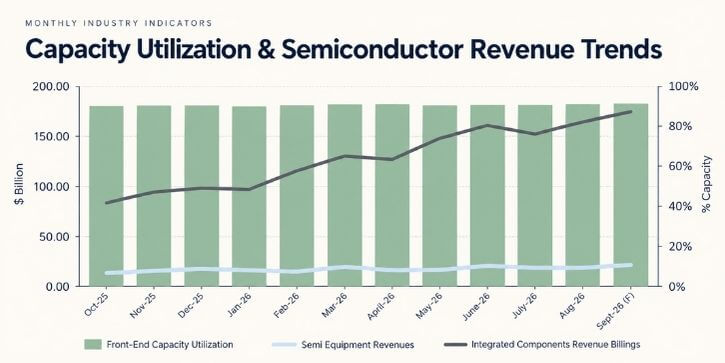
The 2026 semiconductor capex forecast has been revised upward to $301 billion, with most of the increase coming from memory. Memory makers such as SK hynix and Micron, themselves among the largest capital spenders, are directing most of their spending toward HBM and other high-performance memory for AI infrastructure.
Q3 fab utilization is estimated at 90%, rising above 95% at the advanced 5nm and 3nm nodes. Sustained AI and high-performance computing demand is keeping advanced logic, foundry, and memory fabs running at elevated levels as AI processor and HBM production ramps, with fabs taken offline only for required maintenance.
In the August update, Memory Die Bank inventory held steady in dollar terms only because soaring ASPs offset falling unit inventory, and I:B ratios continued to decline. The AI buildout is absorbing advanced memory as fast as it can be produced, delivering record profits to Samsung, SK hynix, and Micron while distorting capacity and investment across the rest of the market. With customers locking in HBM and SSD supply through advance orders and long-term agreements, memory makers expect tight conditions to persist through at least 2027.
 Enlarge
Device Observatory
In August, the Microprocessor Report team covered datacenter AI, edge AI, and RISC-V, including NVIDIA's Vera, Arm’s first chip product, NXP's i.MX 93W wireless SiP, Espressif's RISC-V-based ESP32-S31, and SiFive's P570 Gen 3 CPU IP. Broader coverage followed the push toward specialized AI infrastructure across accelerators, memory and interconnect, optics, automotive computing, and quantum systems. Our Quick Takes covered Intel's Starfire and Terraforce SoCs and recapped Hot Chips 2026. We tracked 21 device launches and five new IP introductions during the month.
To view the full list, read Microprocessor Report August 2026 Review.
Full Reports
Market Observatory
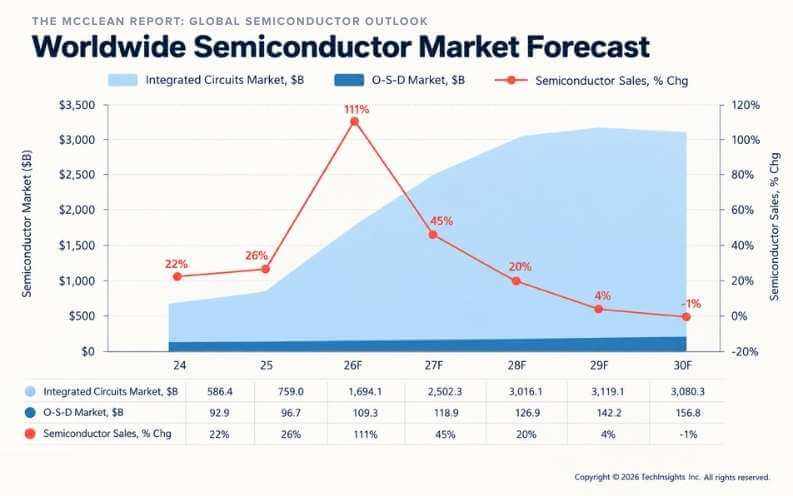
TechInsights has raised its semiconductor market forecast again this quarter. Semiconductor sales are now expected to climb 111% in 2026 to $1,803.4 billion, well above the 67% growth projected in Q1. The AI build-out is driving enormous demand for GPUs and memory, including HBM, advanced DRAM, and NAND flash, but output of advanced logic and memory has not kept pace, sending average selling prices soaring. IC sales are now forecast to rise 123% to $1.69 trillion, while O-S-D sales are projected to grow 13% to $109.3 billion.
Strong growth is expected to continue, with total revenue forecast to surpass $2.6 trillion in 2027 and $3.1 trillion in 2028. AI and datacenter demand should remain robust through most of the forecast period, while supply of key logic and memory components stays tight. Growth in automotive, industrial, and some consumer applications is also expected to resume. A slowdown is not expected until the end of the decade, and even then it should be a soft landing rather than the sharp collapse that has marked most past downturns. From 2025 to 2030, the market is forecast to grow at a CAGR of 30.5%.
If the outlook holds, 2024–2029 would tie 2002–2007 as the second-longest streak of consecutive annual growth, behind the 10-year run from 1986 to 1995. It would also be the first time the market has posted more than three consecutive years of double-digit growth, with every year of the upcycle rising at least 20%.
McClean Report September 2026: Q3 Semiconductor Market Forecast Update
 Enlarge
Interesting Observations
The Most Thought-Provoking Recent TechInsights Reports
The Chip Insider – State of the Semiconductor Union
Where are we in the semiconductor cycle, and what could knock it off course? This report examines the seven layers of the semiconductor demand stack to judge where the industry stands in the current cycle, and projects that semiconductor sales will approach $2 trillion in 2026. It assesses equipment and materials trends, AI and hyperscaler demand, and the macroeconomic backdrop. It also takes a hard look at geopolitical risk, particularly Taiwan-related scenarios, to forecast the industry’s direction through 2027.
Read in the PlatformDatacenter Compute Processors Q1 2026 – CPUs, Custom Silicon, and the Rise of Agentic Infrastructure
GPUs may dominate the headlines, but the datacenter compute race is becoming a full-stack contest. This analysis examines how AI is reshaping datacenter infrastructure, from NVIDIA’s GPU dominance to the accelerating growth of ASICs and hyperscalers’ custom silicon strategies. As agentic AI takes hold, it also makes the case for the CPU’s renewed strategic relevance. By connecting technology roadmaps with market economics and geopolitics, the report identifies the likely winners in the evolving datacenter xPU ecosystem.
Read in the PlatformMemory’s New Rules: Long-Term Contracts Now Decide Who Gets Supply
In today’s memory market, price is no longer the only question; access is. This report examines how soaring memory costs and tight supply are reshaping the smartphone market, as long-term contracts increasingly decide which device makers get supply at all. It projects that memory supply shortages of 20–50% will persist until late 2027, with stabilization unlikely before 2028, when new capacity reaches full production.
Read in the PlatformThe Chip Insider – ASML’s 12-Inch Reticle and the TSMC–Intel Race
A bigger photomask could reshape the race at the leading edge. This report examines the strategic implications of ASML’s move to a 12-inch EUV reticle, and how leadership in lithography technology translates into a manufacturing advantage. It analyzes the competitive dynamics between TSMC and Intel, including Intel’s recent positioning in advanced-node manufacturing with high-NA EUV, and the geopolitical significance of EUV capabilities.
Read in the PlatformApple A20 Pro: The iPhone 18 Pro’s TSMC 2nm Processor
The A20 Pro is the first high-volume smartphone processor built on TSMC’s N2 process, the foundry’s first gate-all-around node. TechInsights’ analysis of the chip in the iPhone 18 Pro finds that Apple kept a six-core CPU configuration but changed the core architecture, added GPU and Neural Engine cores, and made significant changes to the memory interface and packaging. The findings show how strongly on-device AI is now driving Apple’s silicon design choices.
Read in the PlatformRetro Tech
 Enlarge
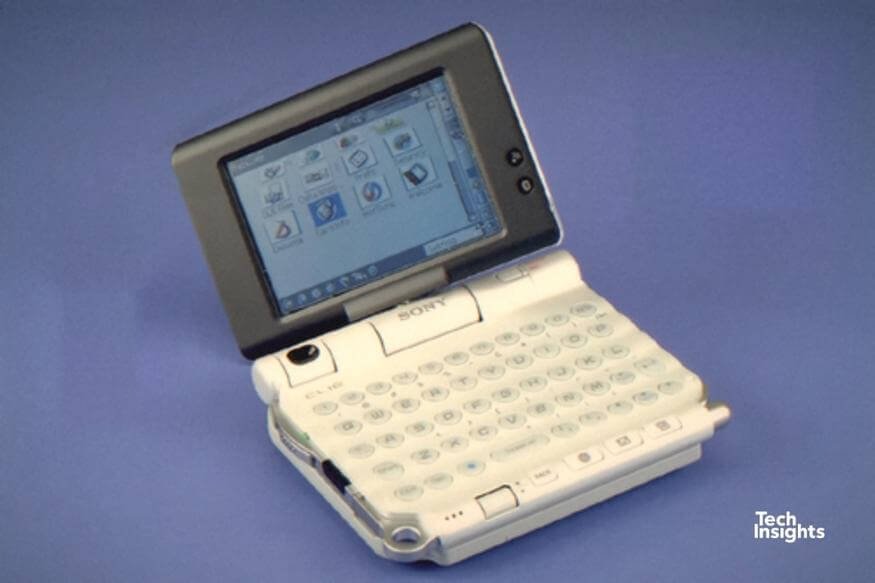
Sony’s CLIÉ UX PDA , released in August 2003, existed in a middle ground between the first wave of subnotebooks popularized by Toshiba’s Libretto series in 1996, and the second wave of subnotebooks kicked off in 2006 by the OLPC XO-1 —an MIT Media Lab project aimed at students in developing economies—that prompted the low-cost ASUS EeePC series.
The CLIÉ UX series was an attempt to bridge Palm OS into a notebook-oriented design, as the UX series measured 105 mm × 89 mm × 18 mm, and integrated an 82 mm (diagonal) touch display manufactured by Sharp with a 480 × 320 display resolution. Sony included a backlit QWERTY keyboard on the UX series, though given the diminutive size, it was more useful for thumb typing than touch typing and included a “jog dial” for navigation. The display was on a hinge allowing it to be flipped and rotated, providing some versatility, likewise, the webcam could be rotated forward and backward.
Two variants were available at retail: the PEG-UX50 included 802.11b Wi-Fi and Bluetooth support for $699, while the PEG-UX40 provided only Bluetooth for $599.
Sony’s custom “Handheld Engine” CXD2230GA SoC debuted in the CLIÉ UX series. This SoC was rather robust for the time: it integrated a 123 MHz ARM926 core with 8 MB of eDRAM, with dynamic clock speed and dynamic voltage scaling, which Sony touted as DVFM (dynamic voltage and frequency management), claiming that it was the “world's first commercial product implementation of such a voltage control function.” The SoC also handled the 2D graphics engine, MPEG-4 hardware codec, camera interface, and Memory Stick interface.
Notably, the CXD2230GA was manufactured at Sony’s semiconductor fab in Nagasaki on a 180nm process. The fab was technically part of Sony Computer Entertainment Inc. (SCEI), the division responsible for the development of the PlayStation.
The CLIÉ UX series shipped with Palm OS 5.2 and included the NetFront 3.0 browser and Macromedia Flash Player 5, with custom Sony-developed software for playing MP3s, sending and receiving email, viewing images, and an app launcher. 16 MB was available for user applications, with 16 MB reserved for backup, and 29 MB partitioned for user media (photos, etc.). The Memory Stick interface supported cards up to 2 GB. Sony’s included software was functional, though few third-party Palm OS applications fully supported the CLIÉ UX's wider display resolution.
Sony ended sales and support of the entire CLIÉ lineup outside of Japan in the summer of 2004, a year after the CLIÉ UX series launched. The CXD2230GA SoC reappeared in the PEG-TH55, released internationally, as well as the PEG-VZ90, a Japan-only Palm-equipped personal media player featuring an OLED screen, one of the first consumer devices to include one. The PEG-VZ90 was the last CLIÉ device to reach stores, as Sony discontinued the lineup in Spring 2005.