Apple iPhone 18 Pro Max Teardown: Inside Apple’s latest flagship
Apple iPhone 18 Pro Max, uncovered.
A20 Pro, Qualcomm X80, Apple N1, and New mmWave Hardware
Beyond the announcement
See what is really inside.
TechInsights’ preliminary teardown of the Apple iPhone 18 Pro Max (A3473) reveals the components behind Apple’s latest flagship, including the A20 Pro processor, LPDDR5X memory, Qualcomm’s Snapdragon X80 modem, Apple’s N1 wireless module, and a newly identified mmWave antenna module.
The early board analysis also shows a diverse semiconductor supply chain spanning Qualcomm, Broadcom, Texas Instruments, STMicroelectronics, NXP, Renesas, Analog Devices, Skyworks, Qorvo, and Apple/Cirrus Logic.
Key Findings
Preliminary board analysis identifies Apple’s latest silicon alongside components from Qualcomm, Broadcom, Qorvo, Skyworks, and other suppliers.
Apple A20 Pro
Application processor paired with LPDDR5X memory and 256 GB NAND flash.
Qualcomm 5G Platform
Snapdragon X80 5G modem with the SDR875 converged RF transceiver.
Apple Wireless Modules
Apple N1 wireless combo module, ultra-wideband module, and mmWave antenna module marked 339M00418.
Broadcom BCM59367
Broadcom wireless charging receiver identified in the device.
Multiple RF Suppliers
RF front-end components from Broadcom, Qorvo, and Skyworks.
Broad Supplier Mix
Power-management components from Apple, Qualcomm, Texas Instruments, STMicroelectronics, and Renesas.
main logic board
A20 Pro and LPDDR5X Memory
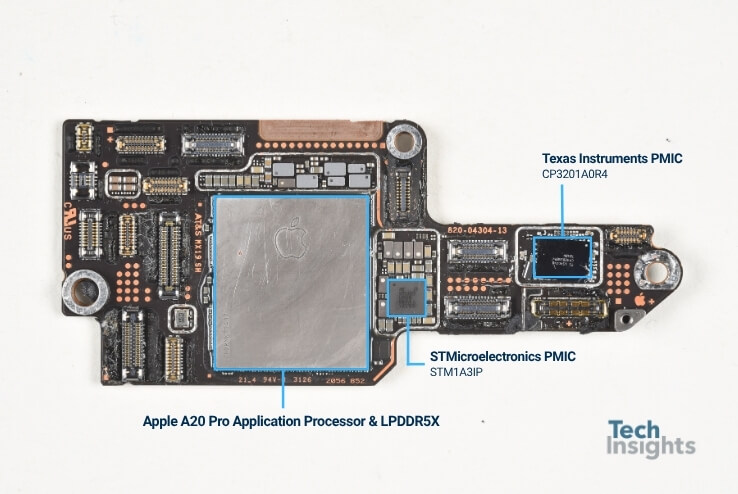
At the centre of the main logic board is Apple’s A20 Pro application processor, paired with LPDDR5X memory.
The surrounding power architecture includes a STMicroelectronics STM1A3IP PMIC and a Texas Instruments CP3201A0R4 PMIC. These components manage the multiple power domains required by the processor, memory, and supporting circuitry.
Further reverse engineering will examine the A20 Pro’s process technology, die design, packaging, and memory configuration.
rf board
Apple N1 Wireless Module & Qualcomm X80 Appears in the Cellular System
The analyzed A3473 contains a Qualcomm Snapdragon X80 5G modem marked SDX80M, alongside Qualcomm’s SDR875 converged RF transceiver.
This is a notable finding because Apple has promoted its C2 modem as part of the iPhone 18 Pro platform. The presence of Qualcomm hardware in this device could indicate regional differences or multiple modem configurations within the iPhone 18 lineup.
Additional device and package-level analysis will be needed to understand Apple’s broader modem deployment strategy.
The RF board also contains:
- Skyworks SKY58480-14 front-end module
- Broadcom AFEM-8257 front-end module
- Broadcom AFEM-8267 front-end module
- Qorvo QM6308A front-end module
- Texas Instruments TPS658A0M PMIC
- NXP NFC controller
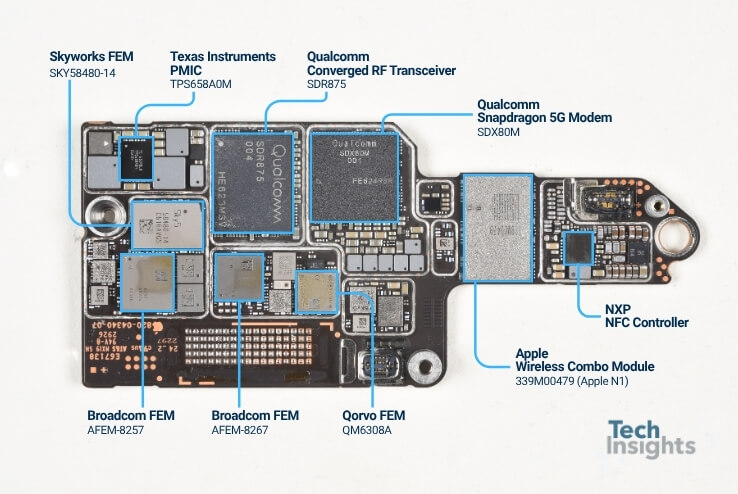
Together, these components support signal amplification, filtering, switching, conversion, and power management across the cellular RF chain.
Apple N1 Wireless Module
The teardown identifies an Apple wireless combo module marked 339M00479 and labelled Apple N1.
The N1 supports Apple’s move toward greater control of wireless connectivity. Further analysis will determine whether this is the same underlying silicon used in the iPhone 17 Pro Max or an updated implementation for the iPhone 18 generation.
Exclusive webinar · Apple iPhone 18
Go inside Apple’s newest Pro iPhones.
Discover what preliminary teardown evidence reveals about Apple’s A20 Pro processor, camera and connectivity systems, component suppliers, packaging, and device cost. Join TechInsights experts for an evidence-based look beyond the Apple announcement.
Register for the Webinar →mmWave Design Carries Over
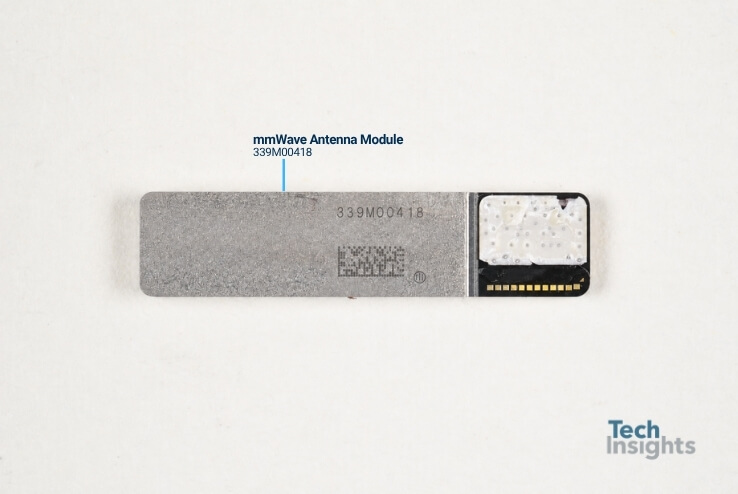
TechInsights identified the Apple-designed, USI-packaged AiP in the iPhone 18 Pro Max, marked 339M00418.
The package contains the same Qualcomm silicon found in the iPhone 17 Pro Max’s QTM565-based mmWave solution, indicating that Apple retained this radio design in the Pro Max. Further analysis will examine the module’s components and packaging.
Power Management Integrated Circuit board
Ultra-Wideband, NFC, and Wireless Charging
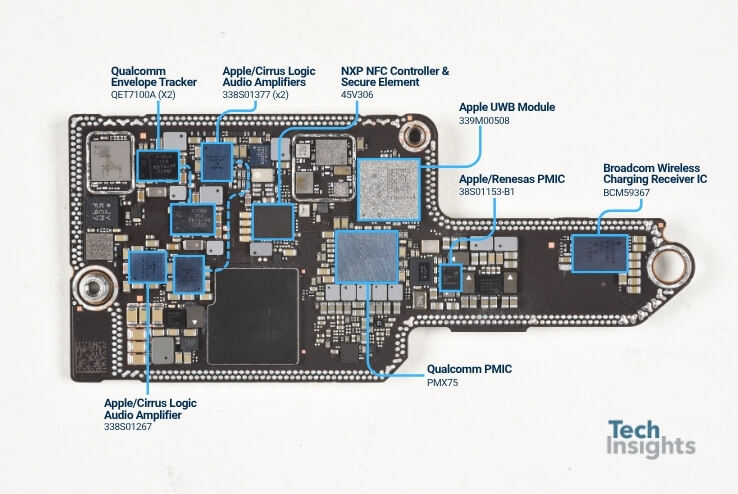
The board includes an Apple ultra-wideband module marked 339M00508 and an NXP NFC controller and secure element marked 45V306.
Wireless charging is managed by a Broadcom BCM59367 receiver IC. Supporting power components include an Apple/Renesas 38S01153-B1 PMIC and a Qualcomm PMX75.
power management IC board
Storage, Audio, and Power Management
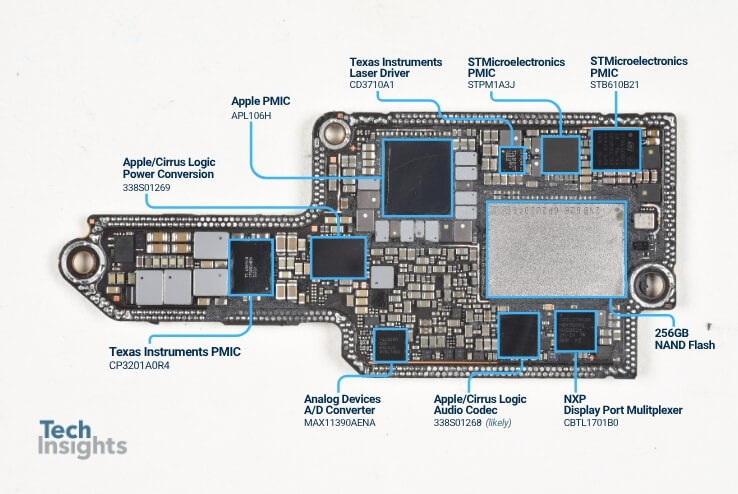
The analyzed device contains 256 GB of NAND flash.
Additional components identified across the boards include:
- Apple APL106H PMIC
- Apple/Cirrus Logic 338S01269 power-conversion device
- Apple/Cirrus Logic 338S01268 audio codec
- Apple/Cirrus Logic 338S01377 audio amplifiers
- Apple/Cirrus Logic 338S01267 audio amplifier
- Texas Instruments CD3710A1 laser driver
- STMicroelectronics STPM1A3J and STB610B21 PMICs
- Analog Devices MAX11390AENA analog-to-digital converter
- NXP CBTL1701B0 DisplayPort multiplexer
- Two Qualcomm QET7100A envelope trackers
The range of supporting components illustrates the complexity of Apple’s power, audio, display, charging, and connectivity architecture.
Analysis in progress
What Comes Next
This preliminary board analysis provides the first look inside the iPhone 18 Pro Max, but deeper reverse engineering is still underway. TechInsights will continue investigating:
- A20 Pro process technology and packaging
- Memory and NAND suppliers
- Apple and Qualcomm modem configurations
- Apple N1 wireless silicon
- The redesigned mmWave module
- RF front-end architecture
- Camera sensors
- Component sourcing
- Bill of materials and manufacturing cost
Stay Ahead of the iPhone 18 Pro Max
Get the Latest Analysis.
Sign up to receive updates as TechInsights releases new teardown findings, reverse-engineering analysis, and insights.
Registered on the TechInsights Platform? Receive the latest iPhone 18 teardown findings, reverse-engineering analysis, and expert insights. Once registered, click Follow on the iPhone 18 page to be notified as soon as new analysis is released.