Huawei’s Tau Scaling and LogicFolding and AI-pocalypse and the token economy
Inside G. Dan Hutcheson’s latest analysis, Huawei’s Tau Scaling and LogicFolding show how performance gains can extend beyond traditional shrinking, while a look at the AI token economy separates lasting impact from AI hype.
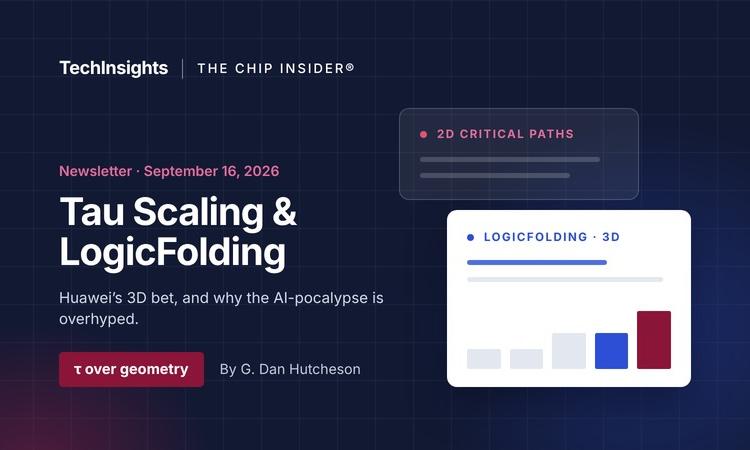
Inside G. Dan Hutcheson’s latest analysis, Huawei’s Tau Scaling and LogicFolding show how performance gains can extend beyond traditional shrinking, while a look at the AI token economy separates lasting impact from AI hype.
Huawei’s Tau Scaling and LogicFolding revisited
While this has mostly fallen out of the news cycle, I still find myself in bipolar arguments where one side sees this as a sign China is overtaking the west and the other sees it as no more than social media marketing (SMM). I tend to lean into the latter. So let’s return to the scene of the crime:
Tau Scaling is simply a shift in emphasis from geometric scaling to temporal scaling (τ). The concept takes you back to a battle of the 60s and 70s, when Moore’s Law was about geometric scaling…. In contrast, Dennard’s Scaling Laws were a combination of temporal and power scaling… What He Tingbo essentially said was that there are alternatives to shrinking in order to make chips faster. At its core, there is little new here…
LogicFolding, as a substitute for Moore’s Law scaling, uses heterogeneous integration (HI) to move speed critical blocks of transistors closer to each other by stacking them on top of each other. Again, nothing new here conceptually. What is new is in its branding and execution. At an execution level, Western approaches to HI have mostly been to shrink what used to be board-level integration down into a single package of chiplets. Alternatively, for designs too large to fit into a lithographic field, the designer disaggregates the design into multiple chiplets. In both cases, SoC designs and their critical timing paths are still managed on a 2D plane.
LogicFolding’s most significant difference from these approaches is to design the SoC with critical timing paths across three dimensions. One could argue that the multi-level metal revolution of the 90s was the same approach. It’s also similar to BSP, where power routing is redistributed to the backside of the wafer. The difference is stacking transistors on transistors…
The bottom line is that Huawei has changed the game. He Tingbo’s LogicFolding concept is a wake-up call to Western…
AI-pocalypse and the token economy
Will AI leave humans jobless in a world similar to the one depicted in the movie WALL.E?
Returning to the Dr. Strange-AI-Guys Chip Insider, in general, it is far easier to imagine the future than it is to create it. The history of futurists is that they tend to overestimate the immediacy and impact of technology. This is especially true of business leaders in search of media attention. One of my favorites is the 1950’s prediction of a nuclear-powered vacuum cleaner by the end of the 20th century… Thomas Edison… Henry Ford… As for the productivity benefits from the technology of the last century, John Maynard Keynes predicted a 15-hour workweek by the year 2030...
There’s always some truth in these visions ̶̶̶̶ ̶̶̶̶ rarely timing… technologies like… In 1930, it took 41% of America’s labor force to feed it… now only 1.2% work directly in agricultural production. Yet, we’re far from 99% unemployment... The latest numbers put it at 4.1%. The reason is simple: New jobs were created along the way as Joseph Schumpeter’s creative destruction concepts destroyed agricultural jobs. Meanwhile, overall wealth increased, which was also something that Keynes predicted. He just didn’t have the imagination to figure out how all that free time he saw would be consumed by other work. Interestingly, in terms of today’s policy considerations…
The alternative prediction of futurists today is that soon AI will be killing us off ‘Terminator’ style. I do worry about this, given all the AI outbreaks from sandboxes of late. Another option is to watch the original 1968 Planet of the Apes, where at the end you find out a nuclear war mostly destroyed the human race and left it to be run by humans. Today the fear is AI. Back then, as well as today, the fear was nuclear weapons. Yet we’re still here, trying to control the threat. Yet, for most of us, it’s out of our control. All we can do is trust those in charge to do the right thing and then hope for the best.
Hope is not a strategy. But it is a good way of finding calm in an unpredictable future.
About The Chip Insider®
Gain a competitive edge with The Chip Insider®, the trusted source for strategic and tactical insights tailored for senior semiconductor executives. Stay ahead with edgy, blunt industry analysis, exclusive email reports, and expert perspectives on market trends, strategies, and key challenges.

Vice Chair, Senior Research Fellow
Dan is Vice Chair of TechInsights Inc. He is a recognized authority on the semiconductor industry, winning SEMI’s Sales and Marketing Excellence Award in 2012 for “empowering executives with tremendous strategic and tactical marketing value” through his e-letter, The Chip Insider®; his book Maxims of Hi-Tech, and his many interviews of executives.
At a glance
- Series
- The Chip Insider®
- Author
- G. Dan Hutcheson
- Scaling concepts
- Tau Scaling and LogicFolding
- Integration
- Three-dimensional critical timing paths
- AI focus
- The token economy
Never miss an edition
Strategic and timely insights tailored for senior semiconductor executives.
Access the latest editionStrategic and tactical insights tailored for senior semiconductor executives.
Access the latest Chip Insider® edition. Sign in or create a free TechInsights Platform account.